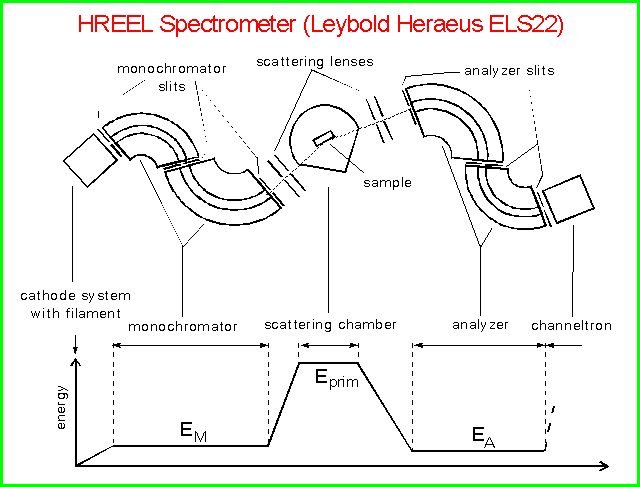

Our HREEL spectrometer
is a Leybold-Heraeus ELS22
with two double-127°-deflectors.
The analysing system is complemented by a LEED system capable of retarding field Auger
spectroscopy, a quadrupole mass spectrometer, and a Kelvin probe.
The adsorption of CO on Ni(311) proved to be very similar to the adsorption of CO on Ni(110). This shows that the crucial structural features that govern the adsorption behavior of this system are the close packed rows.
For hydrogen adsorption on these fcc(311) surfaces the interesting question is whether it first adsorbs in the threefold or in fourfold site since it is known that hydrogen prefers highly coordinated sites and the fcc(311) offers both. On both surfaces it is seen that the hydrogen first occupies the threefold site.
HREELS is the only method available today that is capable of measuring the phonon dispersion of graphite over the whole energy range and throughout the whole Brillouin zone. We measured the graphite phonons in gammaK-direction. We also investigated the phonons for the graphite intercalation compound with Lanthanum. As one might expect the optical phonons soften as compared to pure graphite but interestingly the acoustical modes stiffen. The adsorption of CO on Ni(311) proved to be very similar to the adsorption of CO on Ni(110). This shows that the crucial structural features that govern the adsorption behavior of this system are the close packed rows. For hydrogen adsorption on these fcc(311) surfaces the interesting question is whether it first adsorbs in the threefold or in fourfold site since it is known that hydrogen prefers highly coordinated sites and the fcc(311) offers both. On both surfaces it is seen that the hydrogen first occupies the threefold site.
![[Schematic Drawing of the Apparatus]](./GIFS/dispers.gif) HREELS is the only method available today that is capable of measuring the phonon dispersion
of graphite over the whole energy range and throughout the whole Brillouin zone.
We measured the graphite phonons
in gammaK-direction.
We also investigated the
phonons
for the graphite intercalation compound with Lanthanum.
As one might expect the optical
phonons soften as compared to pure graphite but interestingly the acoustical modes stiffen
which is not fully understood yet. We also perform Born-von Karman calculations to model the
phonon dispersions.
HREELS is the only method available today that is capable of measuring the phonon dispersion
of graphite over the whole energy range and throughout the whole Brillouin zone.
We measured the graphite phonons
in gammaK-direction.
We also investigated the
phonons
for the graphite intercalation compound with Lanthanum.
As one might expect the optical
phonons soften as compared to pure graphite but interestingly the acoustical modes stiffen
which is not fully understood yet. We also perform Born-von Karman calculations to model the
phonon dispersions.